Innovation in Li-ion Battery:
LiFePO 4 Power Battery, Faster charging and
safer performance
Although small capacity Li-ion (polymer) Battery
containing lithium cobalt oxide (LiCoO 2) offers a the best mass energy density
and volume energy density available, lithium cobalt oxide (LiCoO2) is very
expensive and unsafe for large scale Li-ion Batteries.
Recently lithium iron phosphate (LiFePO4) has been
becoming the "best-choice" of materials in commercial Li-ion (and polymer)
batteries for large capacity and high power applications, such as laptops,
power tools, wheel chairs, e-bikes, e-cars and e-buses.
The LiFePO4 battery has hybrid characters: it is as safe
as the lead-acid battery and as powerful as the lithium ion battery. The
advantages of large format Li-ion (and polymer) batteries containing lithium
iron phosphate (LiFePO4) are listed as below:
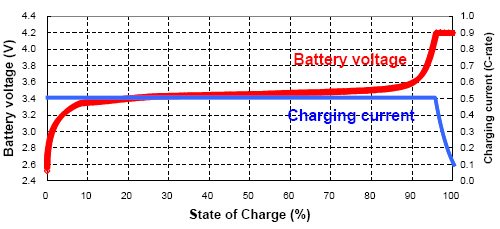
1. Conventional charging
During the
conventional lithium ion charging process, a conventional Li-ion Battery
containing lithium iron phosphate (LiFePO4) needs two steps to be fully
charged: step 1 uses constant current (CC) to reach about 60% State of Charge
(SOC); step 2 takes place when charge voltage reaches 3.65V per cell, which is
the upper limit of effective charging voltage. Turning from constant current
(CC) to constant voltage (CV) means that the charge current is limited by what
the battery will accept at that voltage, so the charging current tapers down
asymptotically, just as a capacitor charged through a resistor will reach the
final voltage asymptotically.
To put a clock to the process, step 1 (60% SOC) needs
about one hour and the step 2 (40% SOC) needs another two hours.
1.
Fast "forced" charging:
Because an overvoltage can be applied to the LiFePO4
battery without decomposing the electrolyte, it can be charged by only one step
of CC to reach 95% SOC or be charged by CC+CV to get 100% SOC. This is similar
to the way lead acid batteries are safely force charged. The minimum total
charging time will be about two hours.
2. Large overcharge
tolerance and safer performance
A LiCoO2 battery has a very narrow
overcharge tolerance, about 0.1V over the 4.2V per cell charging voltage
plateau, which also the upper limit of the charge voltage. Continuous charging
over 4.3V would either damage the battery performance, such as cycle life, or
result in fire or explosion.
A LiFePO4 battery has a much wider overcharge tolerance
of about 0.7V from its charging voltage plateau of 3.5V per cell. When measured
with a differential scanning calorimeter (DSC) the exothermic heat of the
chemical reaction with electrolyte after overcharge is only 90 Joules/gram for
LiFePO4 versus 1600 J/g for LiCoO2 . The greater the exothermic heat, the more
vigorous the fire or explosion that can happen when the battery is abused.
A LiFePO4 battery can be safely overcharged to 4.2 volts
per cell, but higher voltages will start to break down the organic
electrolytes. Nevertheless, it is common to charge a 12 volt a 4-cell series
pack with a lead acid battery charger. The maximum voltage of these chargers,
whether AC powered, or using a car's alternator, is 14.4 volts. This works
fine, but lead acid chargers will lower their voltage to 13.8 volts for the
float charge, and so will usually terminate before the LiFe pack is at 100%.
For this reason a special LiFe charger is required to reliably get to 100%
capacity.
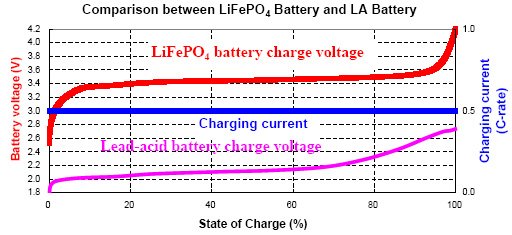
Due to the added safety factor, these packs are
preferred for large capacity and high power applications. From the viewpoint of
large overcharge tolerance and safety performance, a LiFePO4 battery is similar
to a lead-acid battery.
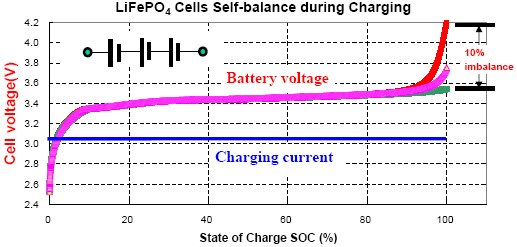
3. Self balance
Unlike the
lead-acid battery, a number of LiFePO4 cells in a battery pack in series
connection cannot balance each other during charging process. This is because
the charge current stops flowing when the cell is full. This is why the LiFEPO4
packs need management boards.
4. Four times higher energy density
than Lead-acid battery
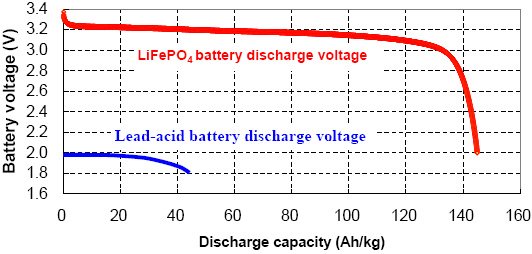
Lead-acid battery is an aqueous
system. The single cell voltage is nominally 2V during discharge. Lead is a
heavy metal, its specific capacity is only 44Ah/kg. In comparison, the lithium
iron phosphate (LiFePO4) cell is a non-aqueous system, having 3.2V as its
nominal voltage during discharge. Its specific capacity is more than 145Ah/kg.
Therefore, the gravimetric energy density of LiFePO4 battery is 130Wh/kg, four
times higher than that of Lead-acid battery, 35Wh/kg.
5. Simplified battery management system and battery
charger
Large overcharge tolerance and self-balance characteristic of
LiFePO4 battery can simplify the battery protection and balance circuit boards,
lowering their cost. The one step charging process allows the use of a simpler
conventional power supplier to charge LiFePO4 battery instead of using an
expensive professional Li-ion battery charger.
6. Longer cycle life
In comparison with
LiCoO2 battery which has a cycle life of 400 cycles, LiFePO4 battery extends
its cycle life up to 2000 cycles.
7. High temperature performance
It is
detrimental to have a LiCoO2 battery working at elevated temperature, such as
60°C. However, a LiFePO4 battery runs better at elevated temperature,
offering 10% more capacity, due to higher lithium ionic conductivity.
|


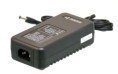 Battery chargers for LiFePO4 packs from
PowerStream. 1-cell to 8-Cell chargers.
Battery chargers for LiFePO4 packs from
PowerStream. 1-cell to 8-Cell chargers.