|
For loose cells and custom
battery packs click here:  For a chart
of the sizes and weights of cylindrical batteries click here: For a chart
of the sizes and weights of cylindrical batteries click here:
For more battery engineering resources
click here:
Pack
Design Considerations
"Ladder", linear, F type, or radial
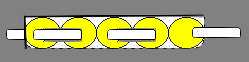
Note that the electrodes
will both come off the top when there are an even number of cells, and one off
the top, the other off the bottom when there is an odd number of cells. With a
connector and heat shrink wrap they look like this:
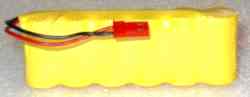
The size of a linear pack is roughly calculated
by the formulaD x nD x H where
D is the diameter of the cell,
n is the number of cells, and
H is the height of the cells.
Multi-row cells
There are two ways to start packing them. One
could be called the cubic, and the other face centered cubic, or
nested.

Cubic packing is in neat rows. The size of
such a pack is nD x mD x H, where n is the
number of cells in a row, m is the number
of rows, D is the cell diameter, and
H is the cell
height. 
Face centered cubic packing is nested to take up
less room. Calculating the size takes a little geometry.
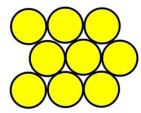
The size is L x W x H
where
L = (n +½)D
W = [0.866(p-1)+1]
D
H=H
p is the number of rows
wide.
If there are alternating long and short rows, such as the 3,4,3
ten cell pack, the formulas are

L = mD
W = [0.866(p-1)+1] D
H =
H
Where m is
the number of cells in the longest layer, and
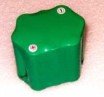
p is the number of layers. With heat shrink it looks like
this:
For a 3 cell pack, you can put the cells in a
tube

The
diameter of the outer circle is 2.16
D.
For a four cell pack in a circular tube

The diameter of
the circumscribed circle is 2.41 D.
Advantages:
 NiMH batteries are smaller and
lighter than lead acid batteries, making them a good choice for high
performance bicycles and scooters. NiMH batteries are smaller and
lighter than lead acid batteries, making them a good choice for high
performance bicycles and scooters.
Over 80% greater run time versus
lead acid of the same size.
Sustained operating voltage
makes the scooter seem to have a fresh charge over most of the operating time.
Lead acid voltage sags continuously over the discharge curve making the scooter
slower through most of the run time.
Also
available in custom voltages, sizes, capacities, and configurations. This is
PowerStream!
Low cost compared with other NiMH manufacturers.
We set
out to design a drop-in replacement for lead acid in personal electric
vehicles. This is a smaller, lighter, better performing replacement, but with a
premium cost.
Data:
The following
comparison tests were done with a 24 volt "Amplifier" electric
scooter:
| |
Lead Acid |
NiMH |
Improvement |
| Battery Format |
2 x 12V SLA Batteries |
20 x 1.2 V D cells |
|
| Rated Capacity |
8 AH |
8.5 AH |
|
| Battery Mass |
5.5 kg (12 lb) |
3.4 kg (7.5 lb) |
40 % lighter |
| Battery Size |
12 x 2.6 x 3.7 in. |
10.2 x 2.4 x 3.6 in. |
24% less volume |
| Maximum operating
current (note 1) |
29.8 Amps |
30.1 Amps |
|
| Average Operating
Current (note 1) |
11.1 Amps |
10.6 Amps |
|
Total run time
(note 4) |
27 minutes |
46 minutes |
70% longer |
Reduced Performance
(note 2) |
21 minutes |
35 minutes |
66% longer |
| Loss Performance
(note 3) |
24 minutes |
45 minutes |
88% longer |
| Test differences |
Multiple rest cycles |
One rest cycle |
|
| Test differences |
Total run time includes three loss of
power events with rests in between |
Test terminated upon the first loss of
power |
|
Notes:
1)156 lb
test engineer on residential/business area test course, almost constant slopes
up and down .
2) Indicated time is the first instance
of a noticeable loss in performance .
3) Indicated
time is the first instance of a complete loss of performance
4) Total run time is greater than the loss of performance time
because the scooter was run again after a rest without recharging.
|





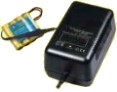 Chargers