How to design products with wall plug-in power
supplies.
Basics
Call them wall mount, AC adapters, wall bumps, power
cubes, wall adapters, wall warts, or wall plug transformers, linear wall mount
power supplies are the most common source of low voltage power. They are the
small plastic boxes that plug directly into the wall. They come in a variety of
performance and quality levels, and generally you get what you pay for. 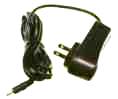
Most design engineers are mostly concerned with the cost
of a wall transformer, and indeed, as AC adapters they can get very very cheap.
It is important, however, to know what you are getting with a wall mount power
supply, and even circuit designers make mistakes in this area.
AC/AC -- First, there is the AC/AC wall mount power
supply. This is a simple step-down low voltage transformer, with AC in and AC
out. There are no other active or passive components. The transformer is
designed to give a certain voltage at a certain current. AC/AC adapters have no
line regulation at all, so their output voltage is proportional to the input
voltage. Wall transformers have a small amount of load regulation, since the
transformer windings are a significant part of the load. 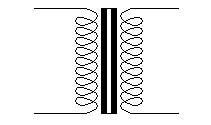
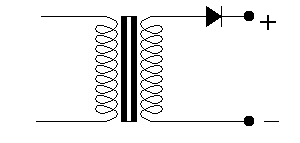
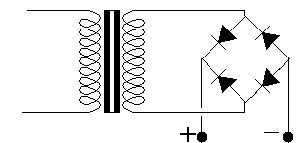
AC/DC-- Add a diode and you have a simple AC/DC
wall mount power supply. The cheapest DC wall transformers use half wave
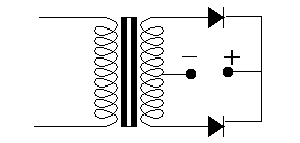
rectification, literally a few cents more gets you a full wave. At one time a
two diode design that used a center tapped transformer was popular, but since
the price of diodes is lower than the price of center tapped secondaries there
isn't much point. In the center tapped version each half of the secondary
transformer winding is idle half of the time, so you have to use a bigger
transformer to get the same power output, which is a lot more expensive than a
tiny speck of silicon rectifier.
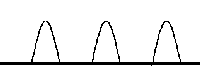
The single diode, half wave rectification DC adapter is
used for the cheapest of battery chargers, toy motors, battery adapters and
other places that the 100% ripple and 50% duty cycle won't matter. Adding a
capacitor can smooth out the ripple, but since it needs a larger capacitor than
full wave bridge rectification, the cost trade off usually leans toward the
full wave rectifier.
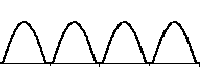
Of course the full wave rectifiers also have 100% ripple,
though the DC component of the power frequency spectrum is much larger than
with half-wave adapters. Add a few cents and you can get a capacitor to smooth
out the ripple to some extent. If ripple is important to you, you had better
specify it, because the bigger the capacitor the more expensive it gets, and
the manufacturers are well tuned to saving money at every opportunity. (See
below for more on ripple suppression trade-offs).
None of the DC wall warts mentioned so far have any line
regulation. It is possible to add a three terminal voltage regulator to the
adapter to perform volt line and load regulation, but because of the limited
heat sinking capability these are limited to low power.
Even if you need well regulated power it often makes sense
to use an unregulated wall wart and do the filtering and regulation in your own
box. This is because the wall mount power supply can be obtained with all the
necessary safety agency certifications, which you would have to do yourself if
you had AC going into your box. Many famous products use AC adapters for this
reason. (See below for more on voltage regulation trade-offs)
More on ripple in DC adapters
The lowest frequency ripple from a linear wall plug-in
power supply which uses a full bridge rectifier is at twice the line
frequency–120 Hz or 100 Hz depending on where you live. The capacitance
for the filter capacitor can be approximated by
C1 (F) = [ ( ILoad ) /(120* Vp-p ripple) ] Farads
(multiply by one million go get microfarads). A quick
insight into this formula is that at 1 mV ripple a 1 amp current will need to
flow into the capacitor for 1/120th of a second, and out of the capacitor for
1/120th of a second. The amount of charge that goes in and out of the capacitor
is delta V times the Capacitance, so C = ILoad/(120*.001) = ILoad*8.3. This
doesn't have the finesse of a tuned filter, and so requires higher capacitance
than, say, a pi filter, but it is the cheapest way to solve the problem.
This capacitor can be either in the AC/DC adapter, or in
your own equipment. The voltage rating of the capacitor should be above that of
the ripple of the raw signal, or 1.414 times the desired DC voltage. A good
rule of thumb is to kill noise where it originates, so it is good to have the
filter capacitor in the wall-mount power supply rather than let all those
harmonics radiate down the cord and filter them in your box.
There will be a lot of frequency harmonics above 120 Hz,
but this capacitor should take care of them, too. It is less practical to try
to use a capacitor to filter out a half-wave rectified wall bump.
Regulation in DC Adapters
Most transformer based wall-mount power supplies have no
active regulation. They are designed so that the voltage will be X when
the current is Y, just like the label says. Many engineers are confused
by this, thinking that a 12 volt, 1 amp power supply can be substituted for a
12 volt 500 mA power supply. This might be true, but the voltage at 500 mA will
be higher than the voltage at 1 amp, maybe 14V. How much this varies depends on
the load line of the transformer. A load-line is a graph of voltage versus
current. PowerStream can supply load lines for our products, not every
manufacturer does. Cheaper transformers have fewer windings, and wilder voltage
swings with load.
Another problem is the line regulation. As the input (or
line) is varied, a simple transformer adapter will vary its voltage
proportionally. Since in the USA the line voltage varies between 105 and 125
volts, your 115 volt nominal input wall wart will vary by 10 % in output (12
volts varies between 13.2 and 10.8 volts) depending on how close you are to the
mains transformer and how much current your neighbors are drawing.
Active Regulation in DC Adapters
Active regulation of wall mount power supplies solves the
regulation problem, and takes care of ripple at the same time. It is surprising
how seldom this is done in the wall bump itself, unless the wall mount is a
switching power supply. Switching power supplies are always regulated.
PowerStream offers regulation as an option in all our OEM power supplies,
linear or switching. In transformer based wall mount power supplies regulation
is done with a diode chain, a zener diode, a zener plus a bipolar transistor,
or a three terminal regulator, depending on the price of components and the
output current required.
Internal fuses
Those wall plug-in power supplies certified by safety
agencies are required to have an internal fuse to protect against fire if there
is a short circuit. They are almost always soldered-in glass tube type fuses,
and are almost never user replaceable. They are protecting the primary side of
the transformer, so are typically rated at 240 volts. Don't get confused by
this rating, even a 110 volt input wall mount transformer will use a fuse rated
at 240 volts. The current rating is typically two to three times the rated
input current.
Isolation of Transformer Adapters
Again, if a wall plug transformer has safety agency
approvals (UL, TUV, CUL, etc.) the input windings of the transformer will be
isolated from the output windings. However, there is a capacitance between the
windings which could result in a small AC leakage current to ground.
Grounding.
Because the wall wart should be properly isolated there is
no need for a polarized connector, or a three pin plug. However, in certain
applications it is useful to have a ground connection to reduce hum. Such wall
plug power supplies are rare, however.
Output connectors
The range of output connectors for wall-plug power
supplies is unlimited, but the most popular are listed on our web page
Power Adaptor Connector
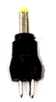
Page The most popular of all is
the 5.5 x 2.1 mm barrel connector, with center positive, shown below.
 |