| September 15, 2020 | |||||||||||||||
Why do large battery NiCad and NiMH packs have small life (and what to do about it) |
|||||||||||||||
|
Custom design and manufacture of state-of-the-art battery chargers, UPS, and power supplies
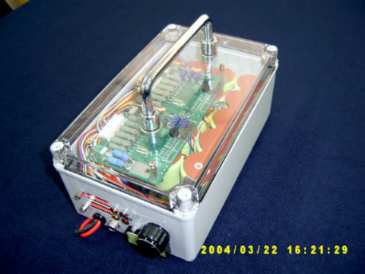
Statement of the problem 1. When many NiCad or NiMH cells are assembled into a single pack the pack often will experience an early failure. This problem starts when you have just 10 cells in series, and gets worse for 20, 30, and 40 cell packs. Some applications need over 100 cells. The reason for the early failure is that when you have cells assembled into a pack there will always be stronger and weaker cells. One of these cells will be fully discharged before the rest of them. In a 3 cell pack this is easy to determine, since the voltage drop will be 1/3 of the total. With 10 cells the voltage drop will be 10% of a voltage that varies between 14 volts and 10 volts. When the pack reaches 10 volts it can mean that all 10 cells have dropped to 1 volt each, or that 9 cells are 11.1 volts, and one is zero volts. For a 30 cell pack, a pack that has dropped to 30 volts may mean that 29 cells are at 1.03 volts, and one cell is zero. Nickel Cadmium and Nickel Metal Hydride cells can be individually discharged to zero volts without damage, but they cannot be reverse charged without generating gas. Eventually pressure will build up to the point that the cells start to vent, which results in permanent capacity loss. This is a particularly difficult problem for applications like electric bicycles, electric wheel chairs and dive lights where you might have 20 or 30 expensive NiCad or NiMH cells in a pack. It is the reason that most projects to replace lead acid batteries with NiCads or NiMH have failed. Several Solutions to the Problem 1. Matched Cells The most common way to solve the problem of early pack failure due to imbalance is to make sure the cells are matched before you assemble them into a pack. This is useful for packs with few cells. As the cell count grows the matching needs to be more and more accurate. At low discharge rates, there is about 3% of the capacity of a typical cell between 1.1 volts and zero volts, about 1% between 0.1 volt and zero volts. So if you match within 3% you should be safe if you discharge to 1.1 volts per cell, and 1% if you discharge to 1.0 volts per cell. (Note, not ±3%, but 3% absolute). However, the cells don't stay matched and after a moderate number of cycles the difference can grow to cause trouble. Furthermore, finding 10 matched cells is a lot easier than finding 30 or 40 matched cells. For larger packs you would need a large pool of cells to draw from. 2. Cut off Voltage. The second way to protect the NiCad or NiMH pack from overdischarge damage is alluded to in the last section. If the cells were perfectly balanced you could discharge to zero volts without any problem. But you can't perfectly balance the cells, and you can't expect them to stay in balance over a large number of cycles. So a common approach is to keep the pack voltage from dropping below the level which is dangerous. So what level is dangerous? Usually for small packs, up to 10 cells the rule of thumb is 1 volt per cell. Panasonic recommends a cut off voltage of 1 volt per cell for packs less than 7 cells, and 1.2 volts for packs from 7 to 20 cells. At low rates of discharge a cut off of 1.2 volts only loses about 2%, but at a discharge rate of 1C you are leaving about 8% in the pack, and at 3C you are leaving 80% of the useful charge in the cells when cutting off at 1.2 volts, and only using 20%. 3. Active monitoring. The best way to solve this problem is to monitor each cell in the pack. When the first one drops to a predetermined level (depending on discharge rate) the entire pack is disconnected from the load. This has the advantage of making the battery last as long as the weakest cell, which is 1000+ cycles for a NiCad and 500+ cycles for NiMH. It also ensures that you can get every last bit of power out of the pack without damaging the pack. Unfortunately the only commecial NiCad/NiMH protection circuit board was made in Korea about 16 years ago, and the company quickly went out of business as lithium batteries took over the world.
|
|||||||||||||||
|
|
|
| |||||||||