| April 19, 2023 | |||
Considerations when charging large supercapacitor banks |
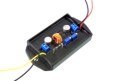 A constant current DC/DC converter for charging supercaps up to 32V at up to 5 Amps |
||
Statement of the problemWhen charging batteries there is a advantage that capacitors don't have. Usually the batteries don't start at zero voltage, and even if they do only a tiny amount of charge is required to get them to a large fraction of the open circuit voltage. Capacitors often start at zero volts and the voltage is proportional to the coulombs of charge. This means that a capacitor charger is very different than a battery charger. A capacitor charger has to deliver a large amount of current at a wider range of voltages.Several Solutions to the ProblemThere are two problems that need to be addressed in choosing a power supply to charge large supercapacitor banks.1) All power supplies need voltage and current regulation. Most of the time the voltage is tightly regulated and the current is free to vary until it maxes out. A current controlled power supply monitors the current and tries to keep it constant by varying the voltage if needed. This means that the output current is monitored and the output current controlled. While most switching power supplies are current limited, the way they act to an overcurrent condition varies. Also, the limit point is usually beyond the recommended operating range of the supply (typically 120% of rated power to allow for surges). Common overcurrent behaviors include: a) Shutdown. The supply stops delivering power and needs to be power-cycled to re-start. b) Hiccup mode. The power supply will shutdown, then restart itself. This will repeat until either the overload goes away, or a component in the power supply fails from trying. This will gradually add charge to the capacitor bank until it is within the voltage and current range of the power supply c) Foldback. This means that the output voltage is reduced. Depending on the slope of the foldback, the current limit point may also be reduced as the voltage drops. Some supplies have a combination of these. For example Meanwell's S-150 series will foldback for mild overloads, and shutdown for larger ones. Foldback is the closest to what is needed for charging batteries or capacitors. But these power supplies are not designed to foldback until the output current is far beyond the rated power. For the S-150 the threshold is about 130% of rated capacity, so the supply is running hot when it is in current limit. This point can be adjusted by changing one fixed resistor. I have also used the SP-320 series for battery charging, but needed to add external circuitry to implement current limiting. The PSP-500 series has an internal pot to adjust the current limit point. This will also gradually increase the charge and voltage on the capacitor bank, though the foldback range (or compliance) is rarely sufficient to let it charge a capacitor bank from zero voltage. 2) The second problem, at least for charging supercapacitors, is over what range of output voltage will the supply deliver continuous power without shutting down or hicoughing. With most batteries, the range of voltage between discharged and fully charged is not very wide, so it doesn't pose much of a problem. With capacitors, the fully discharged voltage is zero. This is a big problem in that most power supplies usually won't work into the dead short, which is what a fully discharged cap looks like. The reason for this is because the operating power for the control circuit is usually derived from an extra winding on the transformer. While this winding is isolated from the output, the voltage it delivers is a fixed ratio of the output voltage. This ratio is chosen by the designer to deliver a operating voltage of 10-12 volts when the power supply is delivering it's nominal output voltage. Depending upon the design, the supply will usually work properly even if this voltage varies by as much as +/- 30%. Unfortunately, there is no ratio that will deliver any operating voltage when the output is zero volts. We have used two possible solutions to this problem. One is to have a linear post regulator to keep the switcher output high enough to keep operating when the capacitor is zero. This linear regulator would be bypassed as soon as the capacitor voltage is high enough for the switcher to continue directly. The second solution would be to have a power source for the operating circuitry that is independent of the output voltage. There are trade-offs between these for efficiency and simplicity. Of course, the trade-offs will vary with the actual power supply chosen, it's minimum operating voltage, and complexity of modifications. PowerStream has experience with chargers for large supercapacitor banks, including UPS systems using supercapacitors for wide temperature range applications and intrinsically safe backups. 3. PowerStream has developed a constant current DC/DC converter that will drop its voltage as low as 25mV in order to keep a constant current of up to 5 amps. It can charge a capacitor up to 32 volts if the input voltage is high enough, and can charge a supercap quickly and accurately. |
|||
|
|
|
| |||||||||